

1 Ton or 1.5 Ton? How to Actually Size Your AC (Most Buyers Get This Wrong)
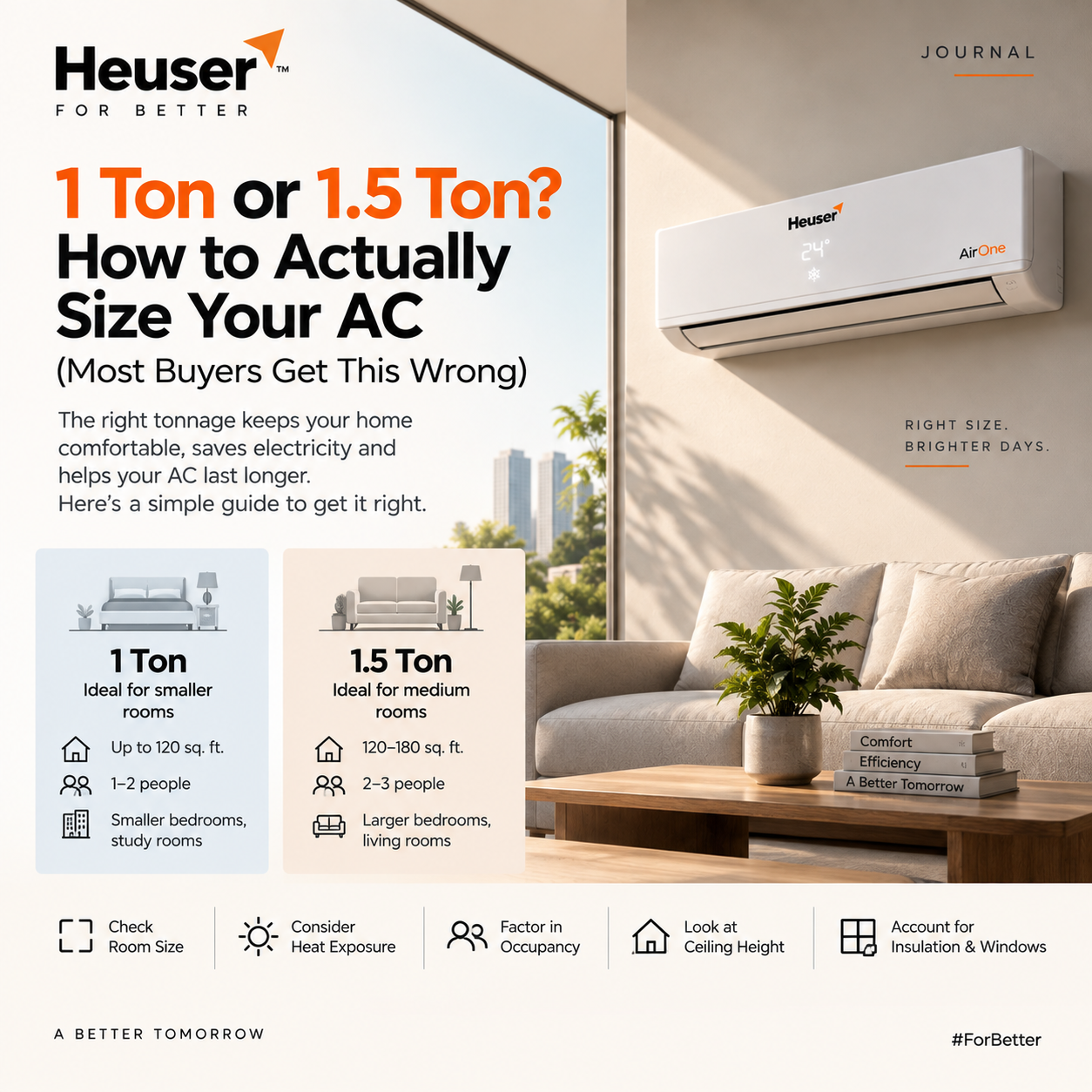
The question that gets answered wrong most often
"What size AC do I need?" sounds simple. In practice, it's the single most common mistake in AC buying — and it's rarely the buyer's fault. Showroom staff often recommend whatever tonnage they have surplus stock of that week, not what the room actually needs.
Get it wrong in either direction and you pay for it — literally — for the next 7+ years.
What "tonnage" actually measures
AC tonnage refers to cooling capacity, not weight. One ton of cooling capacity can remove roughly 12,000 BTU of heat per hour. It has nothing to do with the size or weight of the unit itself — a 1.5 ton AC isn't 1.5 times heavier than a 1 ton one, it just moves more heat per hour.
More tonnage means more cooling power, but also more electricity draw and a higher upfront price. The goal isn't "more" — it's "matched."
Why oversizing is a common but costly mistake
It seems logical: buy a bigger AC, get cooler faster, right? In practice, an oversized AC creates its own problems:
- Short cycling — the unit cools the room quickly, shuts off, then restarts frequently. This is harder on components over time than running a properly sized unit for longer, steadier stretches.
- Poor dehumidification — a big part of what makes a room feel comfortable isn't just temperature but humidity removal. An oversized unit cools the air before it's had time to properly dehumidify it, leaving the room cold but clammy.
- Higher upfront cost for no real benefit — you pay for capacity you don't use.
Why undersizing is worse
An undersized AC runs constantly, straining to reach a temperature it's not built to sustain in that room size. This shows up as:
- Higher electricity bills, since the compressor rarely gets to rest
- Faster wear on components from continuous, uninterrupted operation
- A room that never quite feels properly cool, especially in peak summer
A practical starting guide
These are general starting points — actual sizing also depends on ceiling height, sun exposure, number of occupants, and floor level (top-floor rooms under a roof run hotter):
| Room size | Typical tonnage |
|---|---|
| Up to 120 sq. ft. | 1 Ton |
| 120–180 sq. ft. | 1.5 Ton |
| 180–250 sq. ft. | 2 Ton |
Adjust upward if:
- The room gets direct, prolonged sunlight
- It's a top-floor room directly under the roof
- More than 2 people regularly occupy the space
- The room has a lot of electronics or appliances generating heat
Adjust downward if:
- The room is well-shaded or has good cross-ventilation
- It's used only for sleeping (lower heat load than a living room)
Why this matters more with inverter ACs specifically
Inverter technology (used in both Heuser Air One models) adjusts compressor speed based on real-time cooling demand, rather than switching fully on and off like older fixed-speed units. This makes correct sizing even more valuable — an inverter AC sized correctly for the room runs efficiently at partial capacity most of the time, which is where inverter technology delivers its biggest electricity savings. Oversize it, and you lose much of that efficiency advantage because the unit rarely runs long enough at partial load to benefit.
Heuser Air One: built around the two sizes that cover most Indian homes
Heuser Air One comes in 1 Ton (HAO-12K-3INV) for smaller and mid-sized rooms up to roughly 120 sq. ft., and 1.5 Ton (HAO-18K-3INV) for standard bedrooms and living spaces up to roughly 180 sq. ft. — the two sizes that cover the large majority of Indian residential rooms.
Before you buy
Measure the room. Check for direct sun exposure and floor level. Then match tonnage to the guide above, rather than defaulting to whatever size is being pushed hardest at the showroom. A correctly sized AC is quieter, more efficient, and lasts longer than an oversized one bought "just to be safe."