

Inverter AC vs Non-Inverter: What "Inverter" Actually Means (It's Not Marketing Speak)
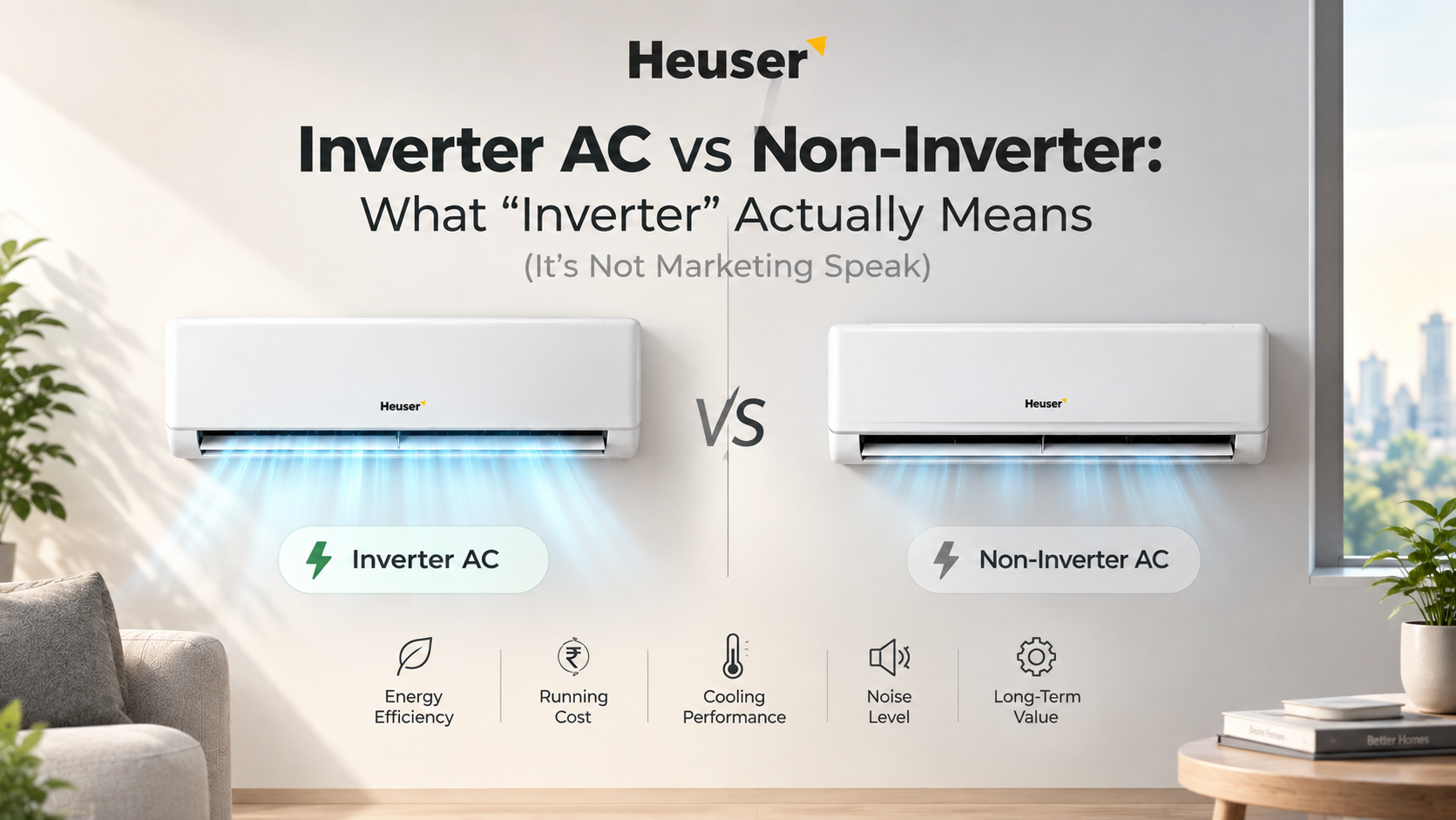
A word that's on every AC box, rarely explained
"Inverter Technology" appears on nearly every AC sold today, printed prominently enough that it's easy to assume it's just a feature, like a remote control or a sleep mode. It isn't. It's a fundamentally different way the compressor operates — and it's one of the few specs that actually changes your electricity bill in a measurable way.
What a non-inverter (fixed-speed) compressor does
A traditional, non-inverter AC compressor runs in only two states: fully on, or fully off. Once the room reaches the set temperature, the compressor shuts off completely. When the room warms up again, it switches back on at full power, cools the room down, and shuts off again.
This on-off cycle repeats continuously for as long as the AC runs — and every full restart draws a spike of electricity, similar to how a car uses more fuel accelerating from a stop than cruising at a steady speed.
What an inverter compressor does differently
An inverter compressor doesn't fully switch off. Instead, it continuously adjusts its speed — running fast when the room needs significant cooling, then slowing down to a lower, steady speed to simply maintain the temperature once it's reached, rather than shutting off and restarting.
This has a few direct effects:
- Lower electricity consumption — avoiding repeated full-power restarts is where most of the efficiency gain comes from
- More stable room temperature — instead of the room drifting a few degrees between cycles, an inverter AC holds a steadier temperature
- Quieter operation — running at a lower steady speed most of the time is generally quieter than repeated full-power startups
- Less mechanical stress — fewer hard stop-start cycles generally means less wear on the compressor over years of use
Why the efficiency gap is bigger than people expect
The difference isn't marginal. Because a fixed-speed compressor draws peak power every time it restarts — and it restarts often, especially in smaller or well-insulated rooms that reach temperature quickly — a non-inverter AC can end up drawing meaningfully more electricity over a cooling season than an inverter unit of the same tonnage, even at the same star rating.
This is also why comparing star ratings across inverter and non-inverter units isn't quite apples-to-apples — the star rating reflects overall ISEER efficiency, but the underlying compressor behavior driving that number is fundamentally different.
Why this connects back to correct sizing
Inverter technology delivers its biggest efficiency advantage when a compressor spends most of its time running at partial, steady speed rather than constantly ramping to full power. This is also why correct AC sizing matters more with inverter units — an oversized inverter AC still reaches temperature quickly and spends less time in its efficient steady-state range, losing much of the advantage the technology is built to provide.
Is non-inverter ever the right choice?
Non-inverter units are typically cheaper upfront and can make sense for spaces used briefly and infrequently, where the AC rarely runs long enough for cycling inefficiency to add up meaningfully. For any room used regularly — bedrooms, living rooms, home offices — inverter technology's efficiency advantage compounds over months and years of use, generally making it the stronger long-term choice despite the higher initial price.
Heuser Air One runs full inverter technology
Both the Heuser Air One 1 Ton (HAO-12K-3INV) and 1.5 Ton (HAO-18K-3INV) use inverter compressors paired with R32 refrigerant, delivering an ISEER of 4.35. The "3INV" in both model names refers to the 3-star inverter classification — efficient technology without paying a 5-star price premium for a payback period that, as covered separately, can take 5–7 years to materialize.
The one-line takeaway
"Inverter" isn't a checkbox feature — it's a different way the AC's compressor behaves every single hour it runs. Understanding that difference is worth more to your long-term electricity bill than almost any other spec on the box.